Sapia of Siena
Sapia of Siena is a penitent soul encountered by Dante and Virgil on the Second Terrace of Mount Purgatory, where the sin of envy is cleansed. Her confession, delivered with a blind man's upturned chin and a voice that reveals her identity through its distinctive phrasing, offers one of the most vivid portraits of envy in the entire Comedy. She is a figure of late repentance, saved not by her own merit but by the charitable prayers of a holy man, and her story dramatizes the purgatorial logic by which the envious are healed through humility and the recognition of their own worthlessness.
Identity and Background
Sapia introduces herself with a bitter pun on her own name: "Sapient I was not, although I Sapia / Was called" . She was a Sienese noblewoman who lived in the late thirteenth century, and her defining characteristic was a perverse delight in the harm that befell others. She tells Dante that she was "at another's harm / More happy far than at my own good fortune" . This inversion of normal human sympathy is the core of her sin: where a virtuous person would rejoice in a neighbor's success and grieve at their misfortune, Sapia did the opposite. Her malice was so ingrained that she prayed not for her own city's victory but simply "for what he willed" — a formula that concealed her hope for her enemies' defeat.
Life and Sin
The specific incident that Sapia recounts occurred when her fellow citizens of Siena were engaged in battle against the Florentines near the castle of Colle di Val d'Elsa in 1269. As the battle turned against the Sienese, Sapia, watching from a safe distance, experienced an ecstasy of joy at their rout. She describes how she "lifted upward my bold face / Crying to God, 'Henceforth I fear thee not,' / As did the blackbird at the little sunshine" . The simile of the blackbird — a traditional emblem of foolishness — underscores the irrationality of her defiance. She believed that because her enemies had been humiliated, she had no further need to fear divine judgment. This moment of blasphemous exultation, in which she openly challenged God, became the defining memory of her life.
Repentance and Salvation
Despite her long career of envy and impiety, Sapia was not damned. She explains that at the very end of her life, "Peace I desired with God at the extreme / Of my existence" . This deathbed repentance, however, would not have been sufficient to save her from a long delay in Purgatory had it not been for the intercessory prayers of Pier Pettignano, a holy friar who "out of charity was grieved for me" . His prayers, offered after her death, shortened her time in Ante-Purgatory and allowed her to ascend to the Terrace of the Envious. This detail emphasizes the communal nature of salvation in Dante's Purgatory: the living can aid the dead through prayer, and a single charitable soul can tip the balance for a sinner who repented only at the last moment.
Encounter with Dante
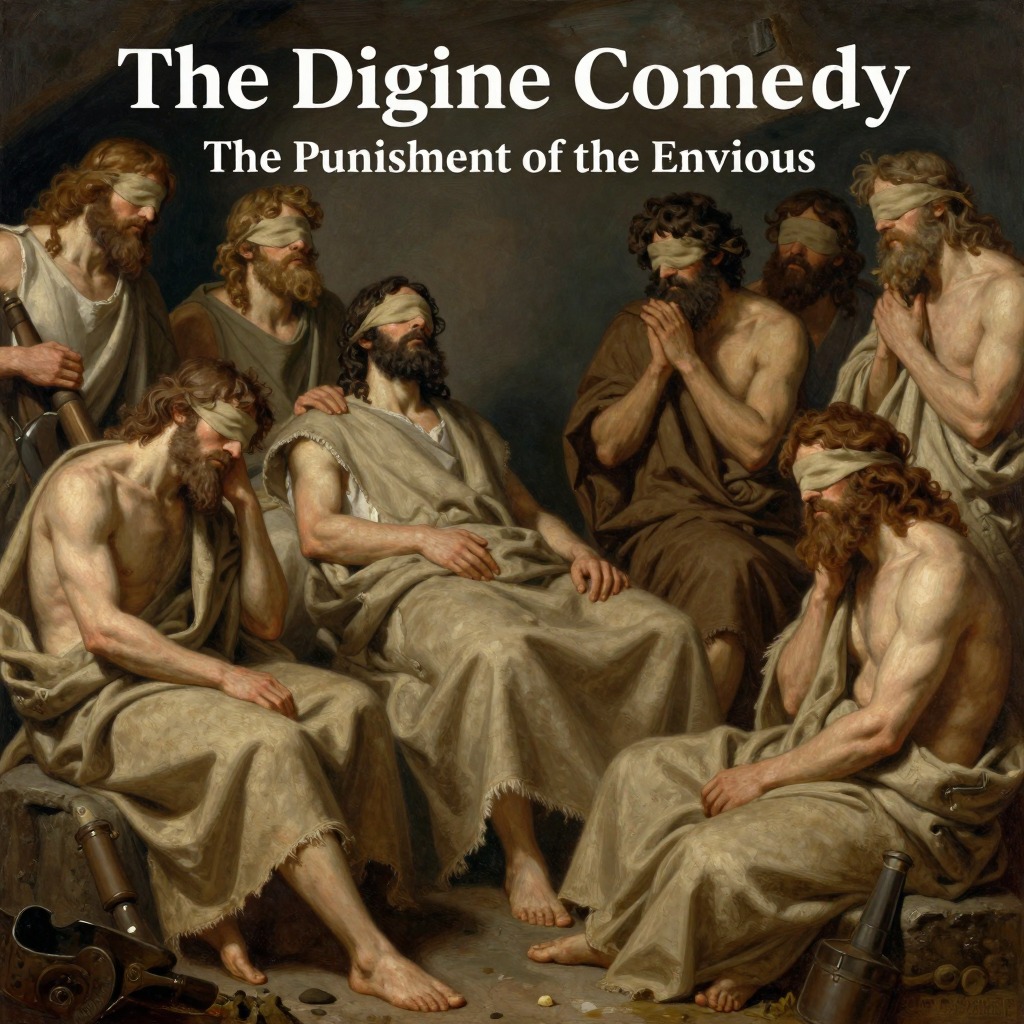
When Dante approaches her, Sapia is seated among the other envious souls, who are clothed in coarse sackcloth and have their eyelids sewn shut with iron wire, a contrapasso that mirrors the envious person's tendency to look askance at others' good fortune. She cannot see him, but she hears his voice and recognizes that he is a living man because he speaks of returning to the world. Their conversation reveals Dante's own vulnerability to envy: he tells her that his eyes "will yet be here ta'en from me, / But for short space; for small is the offence / Committed by their being turned with envy" . He confesses that he fears the punishment for envy more than he fears the torments of Hell, a remark that Sapia finds astonishing. She asks who has guided him to Purgatory, and when he names Virgil, she exclaims that this is "such a novel thing to hear" that it must be a sign of God's special love for him.
Narrative Role and Thematic Significance
Sapia's function in the poem is twofold. First, she provides a concrete example of the sin of envy as it is understood in the Thomistic moral framework that underlies the Purgatorio: envy is sorrow at another's good, and its opposite is joy in another's happiness. Her story illustrates how this sin distorts the soul's relationship with God and neighbor, turning the envious person into a solitary, self-consuming creature who cannot participate in the communal joy of salvation. Second, her salvation through the prayers of Pier Pettignano introduces the theme of intercessory prayer, which will recur throughout the Purgatorio as a mechanism by which the living can assist the dead. Sapia herself, despite her past malice, now participates in this economy of grace: she asks Dante to pray for her and to restore her good name among her relatives in Tuscany, whom she describes as part of "that people vain / Who hope in Talamone, and will lose there / More hope than in discovering the Diana" . This final remark, a prophecy of Siena's futile projects, shows that even in her purgatorial humility she retains a sharp-eyed awareness of her city's folly.